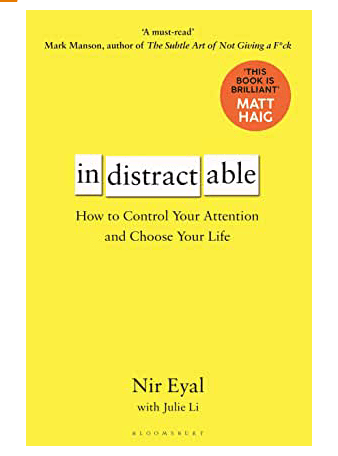
Book Review: Indistractable

This is the new title from Nir Eyal, the author of the well-known ‘Hooked’ which uncovered the research behind how social media (and other tech products) keep their users engaged. This new book took him five years of research and essentially offers advice on staying focused.

The book does a great job of explaining the Human Psychology behind much of what we all experience every day. Nir uses simple terms to cover many academic studies and uses lots of relatable examples.

The essence of the book is down to a neat set of four practices to help avoid distraction. Without going into the detail they deserve, these are:

  • Removing External Triggers – controlling gadgets, environment and people.
  • Controlling Internal Triggers – managing the day and tasks properly.
  • Make Pre-commitments – make pacts to help you stay on task.
  • Make Time – set times for the enjoyable things.

Sweeping insights that get made throughout the book include the proposition that our over-use of technology is actually helping us avoid pain. That might be having specific interactions, honest conversations or trying to work in a dysfunctional culture.

As such busying ourselves with invented tasks (like meetings and email) allow us to do something which looks like progress but often isn’t.

As you’d expect there is a lot about using settings on gadgets and leveraging proper calendar time-boxing to really get things done.

The book clearly focuses on jobs that include a decent amount of solo tasks generating creative output – like writing, programming, or design. That said I don’t think anyone can ignore advice on reducing distraction and this interesting and accessible book is a treat.


Productivity Test: The Pomodoro Technique

I happened across (lifehacker) this productivity technique a few weeks ago and it seemed similar to what I already do. Since the easiest change is the one that is the smallest, I tried it out. Here is a summary.

In essence, this helps you run short periods of focused work, dedicated to a single task. The idea is a dedicated time slot means no lost effort task switching, and distractions are deferred. In fact, dedicated breaks are part of the process and should be strictly non-work. This helps you keep your brain fresh, returning to concentrated on the next ‘Pomodoro’ period.

  1. Choose a task you’d like to get done
  2. Set a timer for 25 minutes
  3. Work on the task until the timer rings
  4. When the timer rings, put a check-mark on a piece of paper
  5. Take a short break – 5mins. Go back to step 2.
  6. Every four 25 minute periods, take a longer break (20-30mins).

The paper record allows you to quantify and report on the effort put into your tasks.

I tried this out and it works pretty well. I used the pomodoro.cc website as the timer and rudimentary task tracker. I found the approach did help focus my attention when deliberately starting out a period of work. The breaks came naturally also, and again starting the next chunk of work made this manageable.

I believe that my own work practice did resemble this kind of stop-start approach anyway, and while I stopped using the timer I do more deliberately focus within each period in the knowledge that a break is coming soon. As such I would rate this 4/5.

Conference Call Meetings: Create High Quality Agenda and Minutes

I find the best meetings are well-defined beforehand. The purpose is clear from the outset, leaving to a quicker time to a clearer and more solid result. Outcome-driven meetings feel more positive and are simpler to arrange too.

Use the following to define an Agenda.

  • Questions or Tasks to be discussed, and ideally why a meeting is needed. Carefully consider scope … try to cover too much and people loose focus. Use a series of small discrete meetings if needed.
  • Roughly what you think the expected outcome might look like.
  • Include Ownership of each topic – who will drive the discussion.
  • Include Outcome Assignment – who is up to address each item.
  • Any recommended pre-meeting reading/preparation.
  • Links to specific related material.

Once the meeting wraps up, send a short email (or create a similar record) with bullet points which summarizes the outcomes. Copy the agenda in and for each item summarize the discussion and the outcome and next steps. If it’s your meeting, you send the minutes, always within 24hours.

Conference Call Meetings: Starting a Project

At the start of a project when many people are remotely located (including from home) it is easy to get sucked into a time-drain succession of meeting-after-meetings without little real demonstrable decisions or progression to show. Meetings are poorly defined, decisions are not recorded clearly, and tasks are not well defined and allocated.

Here is my seven step suggestion to avoid this:

  1. One person is responsible for the completion of project definition.
  2. This person (“definition owner“) states the objective/s, potential approaches, and delivery date estimates in a simple document.
  3. A “Review Team” of stakeholders considers this document and recommend any changes. This can be done in specific meetings or independently using collaboration tools. Adjustments are completed and locked.
  4. The definition owner then expands on this, turning it into a step-by-step high-level project plan.
  5. Again – the Review Team assess the plan and any changes are made immediately. The plan is then locked.
  6. In the final expansion, the definition owner refines the plan into a full detail specification, defines scope, adds work estimates and assignments.
  7. Final appraisal from the Review Team and gives explicit sign-off.

This Week: Adding ‘Control Gaps’ to your Calendar

This week … I had one day where I had almost continuous tasks and meetings booked in my diary. As usual trepidation flavored the first hour of the day, however in an entire fluke there was a gap of about 30 minutes between each Calendar entry. On reflection, I found this made the day ‘logistic-stress’ free, and give me just enough flexibility to get to different places, record outcomes, and be mentally prepared for the next thing. I know some people create 45 minute meetings inside hour slots to add such a cushion, however I think this suggests either not willing to go over, or alternatively you end up back-to-back anyway. So when I am controlling the schedule I will try ensure 30 minute ‘control gaps’ exist in my diary on busy days.